The Village, in better order.
Promenade is the Society’s infrastructure improvement initiative for Lincoln Park.

Lincoln Parkers have restored houses, planted gardens and paid considerable sums for things that are meant to last. Promenade brings that same expectation to the public property around them: water and sewer systems, utility poles, the elevated tracks, station entrances and the walk to the store.
Co-led by Erin McAllister, Director of Membership, and Margot Pemberton, Secretary and Chair of the Standards Committee, the program calls for substantial infrastructure investment alongside thoughtful improvements to the neighborhood’s appearance. It begins around Armitage, Sheffield and Bissell and extends throughout Lincoln Park.
Start underneath the paving.
Promenade’s first priority is replacing worn-out infrastructure. That means investigating recurrent water-main failures, repairing sewers and drainage, replacing unsafe poles and addressing deterioration in elevated structures. Repair plans need to consider the whole block, including the utilities below it.
If excavation turns up a surviving wooden water main, the Society’s position is replacement. No one is proposing that the street retain its original plumbing for character.
Members expect crews to coordinate utility work before new paving goes down. Existing stonework, tree roots, planted parkways and accessible entrances need protection during construction, followed by proper restoration. Margot would like the replacement pavers to match. “Close enough” becomes rather noticeable when it is directly outside your front door.
Quieter trains. Within Lincoln Park.
Armitage’s restored stationhouse and accessibility improvements, and the rebuilding of Fullerton, deserve recognition. CTA’s continuing station-renewal work is welcome. Promenade wants comparable care at other entrances and platforms that need it, with particular attention to the structures between stations.
The Softer Passage initiative calls for reducing train noise as the L passes through Lincoln Park. A professional assessment would identify wheel, rail and structural noise, then determine the appropriate maintenance, track treatments or renewal work. The program also addresses worn finishes, drainage and steelwork, with engineers distinguishing cosmetic deterioration from structural problems.
“You should be able to sit outside with a friend and finish telling her something,” Erin said. “There are three trains in the middle of every story.”
Station approaches matter too: functioning lights, sound steps, readable signs and a clear route from the platform to the sidewalk. The Society would like people to reach dinner without navigating a puddle beneath a leaking stair.

The improvements members expect
Fix the infrastructure.
Reliable water and sewer systems, safe poles and maintained elevated structures. Coordinate the underground work before repaving.
Lower the volume.
Reduce train noise within Lincoln Park and improve the entrances and walking routes around its stations.
Make room for green.
Better-drained alleys and planting beneath the L, without narrowing access for pedestrians or maintenance crews.
Respect what is already here.
Protect streetscapes, shop entrances and delivery access throughout construction. Put the neighborhood back properly afterward.
The alley deserves some attention.
Chicago’s Green Alley approach offers a practical starting point: suitable permeable surfaces, better grading and drainage designed around local conditions. The program includes the ordinary demands of alley life—garages, deliveries, refuse collection and the route people take with a dog in the rain.
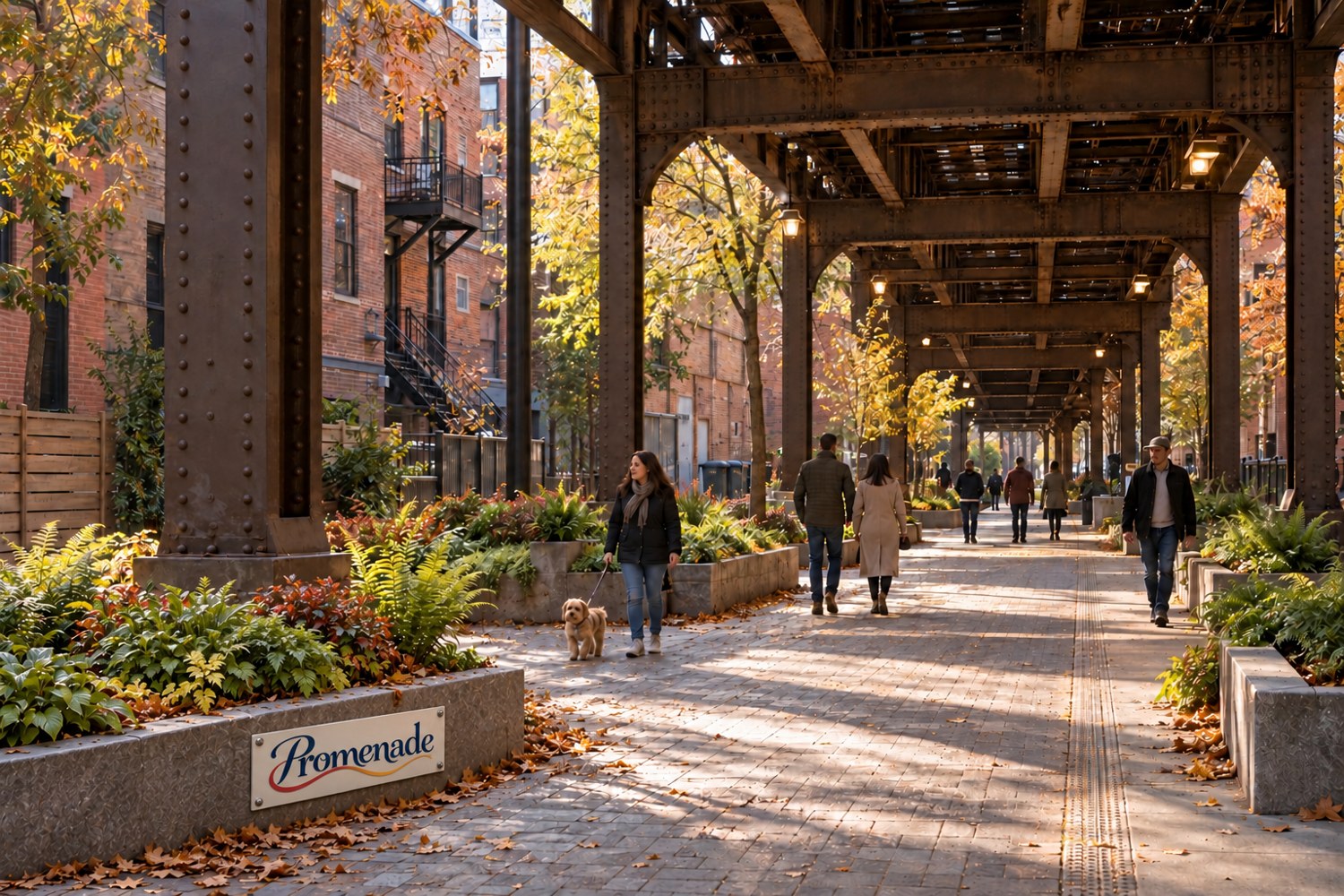
Beneath the L, Promenade proposes shade-tolerant planting, improved lighting and attractive, accessible walking surfaces. Track inspections, drainage and emergency access remain essential. The planting scheme must survive the actual light and moisture available. Members have already lost enough expensive plants on their own terraces.
The aim is a pleasant continuous walk, including the less photographed stretch between a station and Lululemon, rather than a single planter beside the entrance.
Care for the view. Keep the shops open.
Margot’s street-level brief includes tired utility cabinets, damaged signs, abandoned cables and obsolete rooftop antennas. Owners would confirm what is still in use before removing anything. Active equipment must remain accessible; retired equipment need not remain on a building forever.
The same care applies to street furniture and banners. Promenade’s identity belongs on well-made objects at a neighborhood scale, alongside the Society’s flag and Fab Chicago’s familiar wordmark.
Construction planning needs to preserve pedestrian routes and access to shops. Members also expect their groceries, coffee and Restoration Hardware orders to arrive without an expedition from the next block. Erin is asking for delivery arrangements before excavation begins, particularly where loading space is already scarce.
Temporary barriers and signs should make the route clear. At completion, the paving, planting and curbs should be restored—not left as a patchwork souvenir of several different contractors.
Erin and Margot, around the table.
Erin brings members’ everyday experience of the neighborhood; Margot brings the Society’s standards work. Together they will convene residents, local alderpeople and the relevant owners and agencies around specific sites and repairs.

Members are invited to bring photographs of recurring flooding, damaged fixtures, difficult crossings and places where the walk breaks down. The program welcomes the details people who use a block know best: when a loading bay is busy, which entrance is accessible and where water collects after rain.
Promenade’s knitwear will be available for neighborhood meetings. Erin would prefer photographs of the problem before photographs of everyone wearing it.
Touring the Tunnels
Chicago once moved freight beneath downtown through an extensive narrow-gauge tunnel system. Promenade’s proposed Village Extension takes the idea north: a walking route connecting Lincoln Park errands below the weather.
The Society’s concept includes a subterranean Starbucks and a clothing boutique, with accessible entrances, ventilation, drainage and generous fitting rooms.
Members could get coffee and look at sweaters without dressing for the weather twice. A separate feature will explore the route and what it would take to build it.
Bring us your block.
Promenade starts with the places members use every day. Send the Society a location, a photograph and a short description of the improvement you would like to see. Please distinguish your own property from the City’s before offering either for excavation.