The founding.
The first Members wanted an organization of their own in Lincoln Park. They met, introduced friends, and began keeping track of the things they thought mattered. The early apartments were small, but there was usually room for one more person if someone sat on the bed.
The familiar committees took shape early: an Executive Committee, a Foundation, an Editorial Committee, and Membership. Applications arrived, news needed publishing, and someone had to arrange the next gathering.
The website.
The board proposed a website as a way to introduce the Society and keep Members informed. A prospective Member could find the application, while everyone else could catch up on news without waiting for a friend to pass it along.
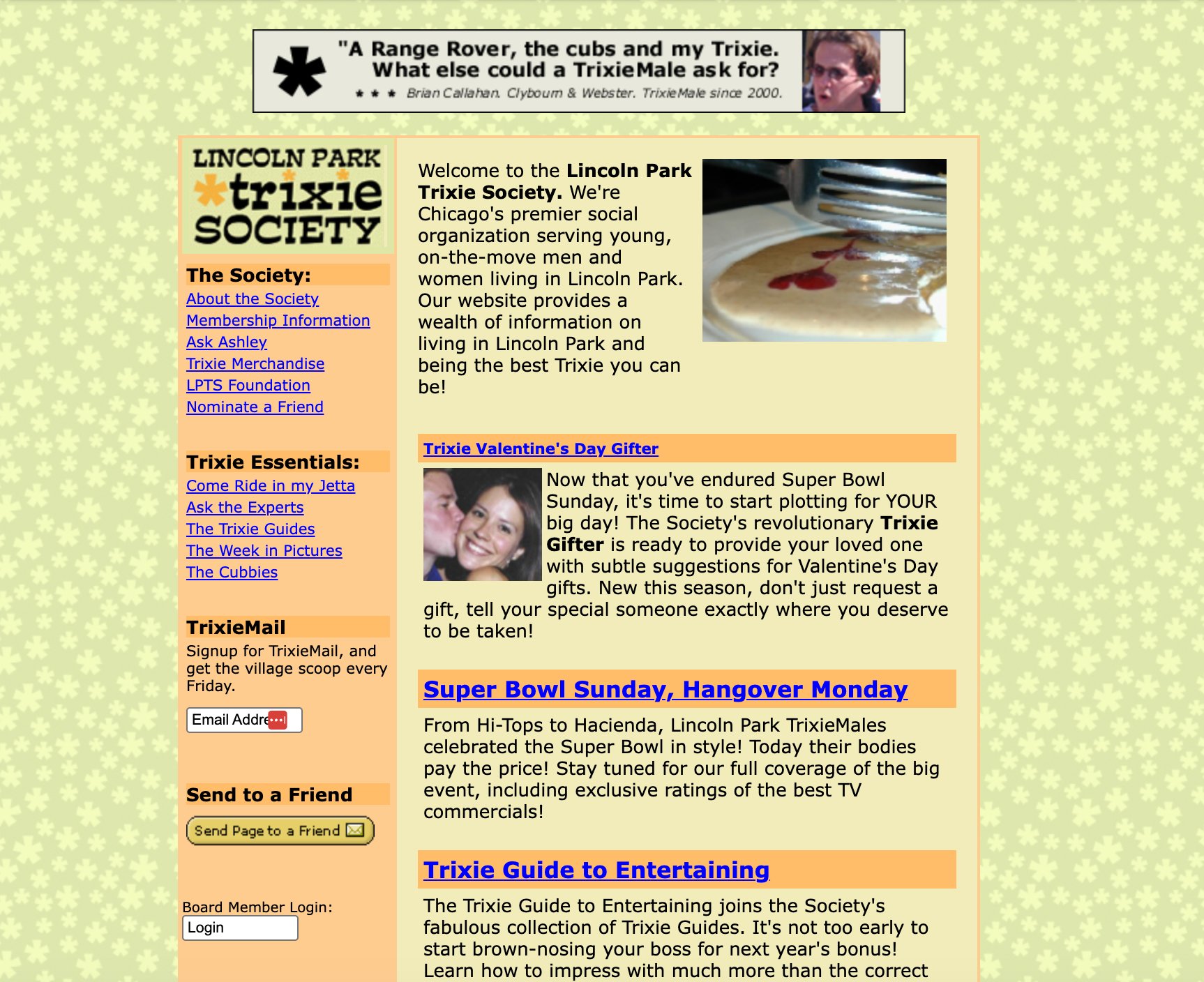
Members hand-coded the site in HTML and launched it at lptrixie.com. It had membership levels, a newsletter, and an editorial calendar. Photographs and reports began to accumulate, including quite a few the subjects had not expected to become history.
The expansion.
Membership grew nearly tenfold after the website launched, with more than 1,500 new Members joining. Many had come to Lincoln Park for work and an apartment near friends. The shops, coffee stops, and train rides soon gave them plenty in common.
Early in the Society’s expansion, the Executive Committee voted four to one to allow men to join, creating the TrixieMale category. The standard was the same as for female applicants: residence within the village, a recognized vehicle, and the cultural fluency the village requires.
Founding Executive Director Ashley Munroe took extended leave after her marriage and the birth of her first child. Interim leadership handled the Society before she returned. Ashley’s own accounts tend to give more space to the founding apartment.
The Fox 32 segment.
Fox 32 reporter Mark Saxenmeyer visited Lincoln Park to explore the Trixie identity and the Society's website. He spoke with local women about the neighborhood, shopping, personal style, and how much they recognized themselves in the description. His search for Society representatives and the studio discussion of our CTA seating proposal are also preserved in the recording.
The Jettas and the desktop-era website mark an early chapter. The Society's interests have broadened with its Members: dinners at the Alehouse, Range Rovers outside single-family homes, and a glass of wine over a round of beers. There is still room for a night out, and for Members finding their own way through the village. Our guides and Member tools have grown with us. Watch the original Fox 32 feature in the Society Archive.
A cultural publication.
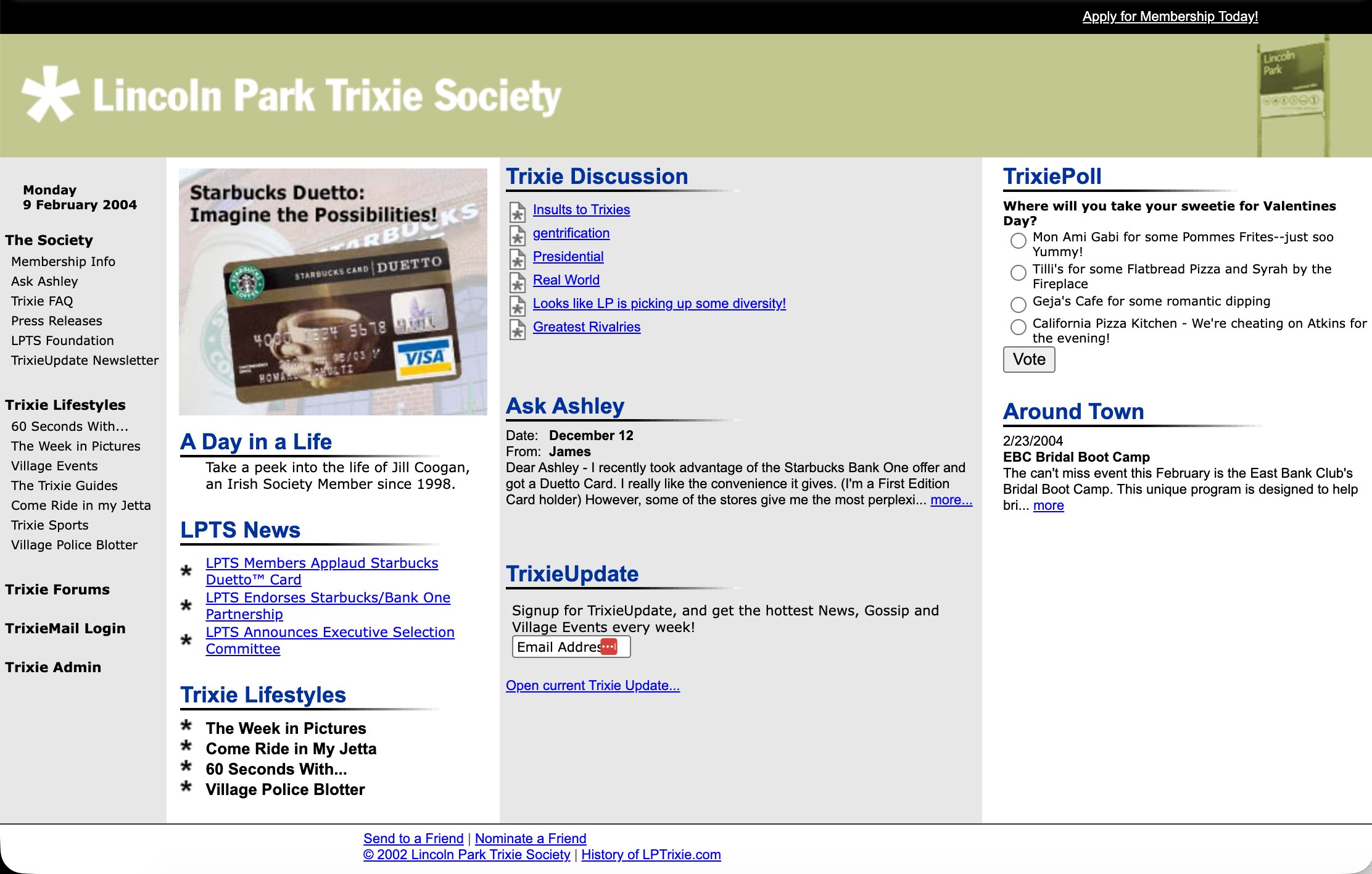
The Week in Pictures became a regular record of Members and neighborhood life. The Police Blotter gave shopping, parking, and social mishaps the attention their participants felt they deserved. Readers outside the membership began following along.
The Editorial Committee published Trixie Guides to apartments, shopping, and entertaining, alongside Features and Come Ride in My Jetta. Members wrote about work, friends, boyfriends, and what had happened on the way home. The Annual Champagne Brunch at the Drake gave many of them a reason to meet in person.
The institution.
The roster grew to more than 3,000 Members in good standing. The Foundation added support for the Stockton Drive wisteria archway, the Conservatory’s palm room, the Lincoln Park Zoo gala, and arts education. Caroline would eventually become closely identified with the archway.
The original website remained familiar to Members: its photographs, columns, and shop notices were part of the routine. New entries joined older ones instead of replacing them.
Proposals also arrived from outside Chicago, including an effort to establish a San Francisco chapter and inquiries from New York and Los Angeles. The Society considered them from Lincoln Park. There were people to meet and local arrangements to understand before granting a charter.
The recalibration.
The financial crisis affected Members differently. Some households cut back or moved; others stayed put and reconsidered their plans. The Society’s bulletins called certain job changes “sudden and irregular employment outcomes.” Friends usually knew the fuller story.
Members kept in touch through those changes. A new address did not make an old friendship less useful, particularly when someone needed advice, a contact, or simply dinner out.
The Foundation adjusted the timing of its giving, and the Champagne Brunch went ahead. Members had plenty to discuss at the tables.
The legacy period.
The neighborhood continued to change. Members who loved their first studios could also have detailed views about a single-family house. The archive acquired photographs of larger kitchens, rear decks, and the occasional construction project that had outlasted everyone’s patience.
Fitness classes, coffee shops, and grocery runs found their way into the Society’s reports. So did the goldendoodle. Members who once compared Jetta colors now also compared trainers, kitchen fittings, and which dog had appeared in whose holiday card.
Instagram gave Members another place to post. Jill continued to ask for photographs for the Journal, preferably with names and a description that would make sense after the weekend.
The coordinated response.
During the pandemic, Members worked from home, changed their plans, and found ways to stay in touch. Meetings and gatherings had to be reconsidered around the circumstances of each household.
The Week in Pictures recorded masked outings, distanced gatherings, and unusually quiet neighborhood scenes. Brunch took a modified form, the Doodle Pool went private, and ordinary establishment reviews paused.
When vaccines became available, Members shared information about eligibility and appointments. The Society helped pass that information along through private channels. It was useful work, and Members remembered who had helped them find what they needed.
The substantial gains.
Other subjects eventually returned to the conversation: summer houses, travel, school calendars, and the next dinner. A meeting could begin with Foundation business and end with several people comparing plans for Harbor Country.
The photographs show Range Rovers, Cayennes, Rivians, and houses with room for a proper party. They also show newer Members beginning much as earlier ones did, with a small apartment and an ambitious list of things to buy for it.
There is affection for both. The old studio may have had the wrong stove and nowhere to put a dining table, but everyone remembers the people who came over.
The relaunch.
The Society redesigned its website and introduced the current Trixie Shop. It also formalized The Doodle Pool and the Approved Establishments Directory, giving familiar Member interests their own places on the site.
The Society also published, for the first time, formal endorsements of three Chicago animal welfare organizations: the Anti-Cruelty Society, PAWS Chicago, and One Tail at a Time.
The Journal continues to follow whatever Members find interesting. New voices and new neighborhoods join an archive that still has room for a Jetta trip, an apartment search, or a very long lunch.
The continuing work.
The continuing work is shared among the officers, committee volunteers, and Members who send in photographs and stories. The Foundation reviews proposals, Whitney arranges the gatherings, and Erin welcomes the next intake.
Other cities are still asking about chapters. The expansion officers review them while the Founding Chapter carries on in Lincoln Park. There is another meeting to arrange, and someone has suggested dinner afterward.